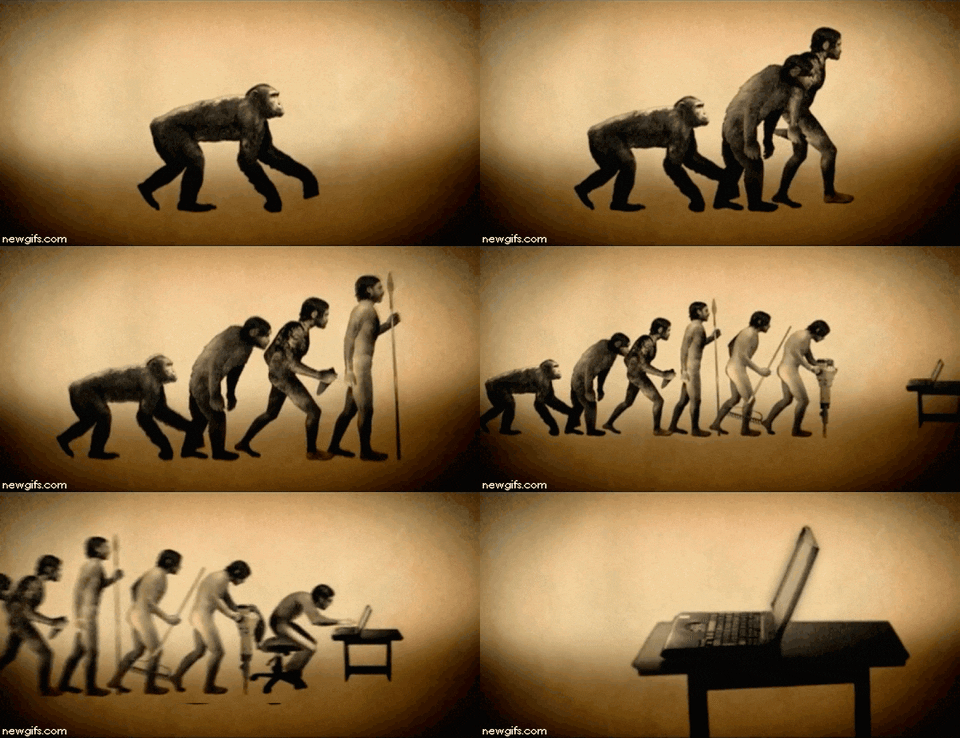
Human Beginning
Most of what is written below are quotations. The reader may
wish to be comforted that scholars, not the blog writer, researched the points
made.
Early humans were not that unusual. “Nobody, least of all
humans themselves, had any inkling that their descendants would one day walk on
the moon, split the atom, fathom the genetic code and write history books.” Harari,
(p. 4). What is set humans apart is extraordinarily
large brains especially compared “to other animals. Mammals weighing 130 pounds
have an average brain size of 12 cubic inches. The earliest men and women, 2.5
million years ago, had brains of about 36 cubic inches. Modern Sapiens sport a
brain averaging 73–85 cubic inches. Neanderthal brains were even bigger.” Harari,
(pp. 8-9). A giant brain “is a jumbo
drain on the body. It’s not easy to carry around, especially when encased
inside a massive skull. It’s even harder to fuel.” Harari, (p. 9).
Most mammals are born to join the herd or pride with a need
to keep up, even if they need some protection and education. By contrast “humans
emerge from the womb-like molten glass from a furnace. They can be spun,
stretched, and shaped with a surprising degree of freedom. Therefore, today we
can educate our children to become Christian or Buddhist, capitalist or
socialist, warlike or peace-loving.” Harari, (pp. 10-11). They also can choose
to reject these teachings even if there are consequences. Freedom is a key to
accomplishment and ostracism.
” One of the most common uses of early stone tools was to
crack open bones in order to get to the marrow. Some researchers believe this
was our original niche. Just as woodpeckers specialize in extracting insects
from the trunks of trees, the first humans specialized in extracting marrow
from bones. Why marrow? Well, suppose you observe a pride of lions take down
and devour a giraffe. You wait patiently until they’re done. But it’s still not
your turn because first the hyenas and jackals – and you don’t dare interfere
with them – scavenge the leftovers. Only then would you and your band dare
approach the carcass, look cautiously left and right – and dig into the edible
tissue that remained. This is a key to understanding our history and
psychology. Genus Homo’s position in the food chain was, until quite
recently, solidly in the middle. For millions of years, humans hunted
smaller creatures and gathered what they could, all the while being hunted by
larger predators. It was only 400,000 years ago that several species of man
began to hunt large game on a regular basis, and only in the last 100,000 years
– with the rise of Homo sapiens – that man jumped to the top of the food chain.
That spectacular leap from the middle to the top had enormous consequences.
Other animals at the top of the pyramid, such as lions and sharks, evolved into
that position very gradually, over millions of years. This enabled the
ecosystem to develop checks and balances that prevent lions and sharks from
wreaking too much havoc.” Harari, (p. 11). (emphasis not in original text) We
were not ALWAYS at the top of the food chain.
“Some human species may have made occasional use of fire as
early as 800,000 years ago. By about 300,000 years ago, Homo erectus,
Neanderthals and the forefathers of Homo sapiens were using fire daily. Humans
now had a dependable source of light and warmth, and a deadly weapon against
prowling lions… may even have started deliberately to torch their neighborhoods.
A carefully managed fire could turn impassable barren thickets into prime
grasslands teeming with game. …once the fire died down, Stone Age entrepreneurs
could walk through the smoking remains and harvest charcoaled animals, nuts and
tubers. But the best thing fire did was cook. Foods that humans cannot digest
in their natural forms – such as wheat, rice and potatoes – became staples of
our diet thanks to cooking. Fire not only changed food’s chemistry; it changed
its biology as well. Cooking killed germs and parasites that infested food.
Humans also had a far easier time chewing and digesting old favorites such as
fruits, nuts, insects and carrion if they were cooked. Whereas chimpanzees
spend five hours a day chewing raw food, a single hour suffices for people
eating cooked food. The advent of cooking enabled humans to eat more
kinds of food, to devote less time to eating, and to make do with smaller teeth
and shorter intestines. Harari, (p. 12). (emphasis not in original text)
“Despite the benefits of fire, 150,000 years ago humans were
still marginal creatures. They could now scare away lions, warm themselves
during cold nights, and burn down the occasional forest. Yet counting all
species together, there were still no more than perhaps a million humans living
between the Indonesian archipelago and the Iberian Peninsula, a mere blip on
the ecological radar.” Harari, (p. 13).
“There must have been a point when the two populations were
already quite different from one another, but still capable on rare occasions
of having sex and producing fertile offspring. Then another mutation severed
this last connecting thread and producing fertile offspring. Then another
mutation severed this last connecting thread, and they went their separate
evolutionary ways. It seems that about 50,000 years ago, Sapiens, Neanderthals , and Denisovans were at that borderline point. They were almost, but not quite,
entirely separate species.” Harari, (pp. 16-17).
“Imagine a Sapiens band reaching a Balkan valley where
Neanderthals had lived for hundreds of thousands of years. The newcomers began
to hunt the deer and gather the nuts and berries that were the Neanderthals’
traditional staples. Sapiens were more proficient hunters and gatherers –
thanks to better technology and superior social skills – so they multiplied and
spread. The less resourceful Neanderthals found it increasingly difficult to
feed themselves. Their population dwindled and they slowly died out, except
perhaps for one or two members who joined their Sapiens neighbours.” Harari,
(p. 17). It could have been that Sapiens were simply more numerous, better at
pack tactics, adapted to Neanderthals tactics more quickly and/or had better
weapons. Perhaps Sapiens interbred and simply absorbed a smaller Neanderthal
group.
Lesson here: Humans have bigger brains, hence more
intellectual potential. It was a roll of the dice that paid off with cooked
food, that was less dangerous, easier to eat and digest. Social skills helped
with larger scale cooperation that helped the species dominate over more
formidable adversaries.
Human Settlement and Migration
As any species migrates it either 1) fills the virgin land
2) lives in coexistence with creatures already there (similar to the
Interbreeding Theory in Harari p.14)) 3) battles with creatures already there (similar
to the Replacement Theory in Harari p.14). This is a critical REALITY.
Polynesian Hawaiians appear to be one group that settled the
virgin, (human) unsettled Hawaiian Islands. Anything that lives on Hawaii which
is thousand of miles remote from other major land masses, had to arrive by one
of the 3 W’s – wings, waves or wind. Often, migration must deal with existing
creatures. For coexistence there must be a mutual desire on both sides. If one
side does not agree then there will be conflict. This could be from mild
disagreements that may be resolved to genocide. “Explaining how some people
come to dominate other people,… is more often used to try to alter an outcome
than to repeat or perpetuate it…psychologists try to understand the minds of
murders…why social historians try to understand genocide…why physicians try to
understand the causes of human diseases.’ Diamond, J. Guns, Germs and Steel
p.7
Some people dominate others by superior intellect,
technology, guile, better stamina (including disease resistance) and luck.
It is
important to know where we came from, what we did to determine what it is we
are likely to do. This may be thought of as culture. Culture will be discussed
separately. Whether we think of ourselves as an evolution from the primordial
ooze or springing directly as a creation of God can give clues as to how we may
react now and in the future.
What we know
of history can be a matter of chance.
Does that mean that something is important only because it
survived? One should perhaps remember
that first rule that we spoke of namely survival. The only way one can judge,
if anything is important is to be able to examine it. It must exist. If it does
not exist, one has nothing to consider. It has been said that the conquerors
write history. This is because they can decide what or who survives or not.
This goes to Rule 1, one must survive.
Even if there
are no human inhabitants to contend, the Maoris, New Zealand’s first Sapiens
colonizers, reached the islands about 800 years ago. Within a couple of
centuries, the majority of the local megafauna was extinct, along with 60 per
cent of all bird species. Harari, Yuval Noah. Sapiens: A Brief History of
Humankind (pp. 66-67). HarperCollins. Kindle Edition.
In Australia
“large animals – the primary victims of the Australian extinction – breed
slowly. Pregnancy is long, offspring per pregnancy are few, and there are long
breaks between pregnancies.” Harari, (p. 67). Even killing a few
could reduce reproduction below sustainability. A similar fate befell the
mammoth and chasing (or following) them to Alaska may be the reason for North
American human population.
The first Polynesian
settlers arrived in Hawaii around 500 A.D. who brought pigs, horses, sheep,
goats and dogs with them. Scientists believe that at that time, the Hawaiian
Islands were inhabited by some 67 species of birds, of which a third are
extinct today. https://www.to-hawaii.com/fauna.php
The point is
ANY migration will change the environment whether intended or not.
History also
helps us understand how we fit into the universe. ©