The Cognitive Revolution - Language
The appearance of new ways of thinking and communicating,
between 70,000 and 30,000 years ago, constitutes the Cognitive Revolution. What
caused it? We’re not sure. The most commonly believed theory argues that
accidental genetic mutations changed the inner wiring of the brains of Sapiens,
enabling them to think in unprecedented ways and to communicate using an
altogether new type of language. We might call it the Tree of Knowledge mutation.
Why did it occur in Sapiens DNA rather than in that of Neanderthals? It was a
matter of pure chance, as far as we can tell. (Harari, Sapiens, p. 21)
Every animal has some kind of language. Even insects, such
as bees and ants, know how to communicate in sophisticated ways, informing one
another of the whereabouts of food. (Harari, Sapiens, p. 22)
Primitive people do not equate to dumb. “Modern Stone age
peoples are probably more intelligent not less intelligent than industrialized
people.” (Diamond, Guns, Germs and Steel, p. 19) He goes on to say that Modern
Stone age people must contend with tribal warfare that proportionally claim a
higher percentage of the population, accidents without medical remedies and a
less certain food supply.
Cognitive Revolution is accordingly the point when history
declared its independence from biology. Until the Cognitive Revolution, the
doings of all human species belonged to the realm of biology. (Harari, Sapiens,
p. 37)
…stories that people invent and tell one another. There are no gods in the universe, no nations, no money, no human rights, no laws, and no justice outside the common imagination of human beings. (Harari, Sapiens, p. 28)
It is a mistake to look for the differences at the level of
the individual or the family. One on one, even ten on ten, we are
embarrassingly similar to chimpanzees. Significant differences begin to appear
only when we cross the threshold of 150 individuals, and when we reach
1,000–2,000 individuals, the differences are astounding. If you tried to bunch
together thousands of chimpanzees into Tiananmen Square, Wall Street, the
Vatican or the headquarters of the United Nations, the result would be
pandemonium. By contrast, Sapiens regularly gather by the thousands in such
places. Together, they create orderly patterns – such as trade networks, mass
celebrations and political institutions – that they could never have created in
isolation. The real difference between us and chimpanzees is the mythical glue
that binds together large numbers of individuals, families and groups. This
glue has made us the masters of creation. (Harari, Sapiens, p. 37)
Language is
amazingly supple. We can connect a limited number of sounds and signs to
produce an infinite number of sentences, each with a distinct meaning. We can
thereby ingest, store and communicate a prodigious amount of information about
the surrounding world.
Our language
evolved as a way of gossiping. According to this theory Homo sapiens is
primarily a social animal…. important
for them to know who in their band hates whom, who is sleeping with whom, who
is honest, and who is a cheat. (Harari, Sapiens, p. 22-3)
Communication need not be verbal. Visual clues such as
facial expressions, violence, sign language, touch, dance, art, etc., are all
examples of nonverbal communication. However, spoken language can bind larger
groups to more complex issues.
Reliable information about who could be trusted meant that
small bands could expand into larger bands, and Sapiens could develop tighter
and more sophisticated types of cooperation.
…vast majority of human communication – whether in the form
of emails, phone calls or newspaper columns – is gossip. (Harari, Sapiens, p. 22-3)
What this means is humans are all about their stories,
be they myths about gaps in human knowledge like primitive tribal Earth
creation stories. Stories are the basis of belief and faith. It spawned
everything from religion to keeping up with popular cultural icons. Humans can
be passionate about these stories. They can bind a like-minded group together.
They are at the heart of clubs, teams, tribes, regions, nations, and more. But
there can be no stories without communication and language is a high form of
communication. ©
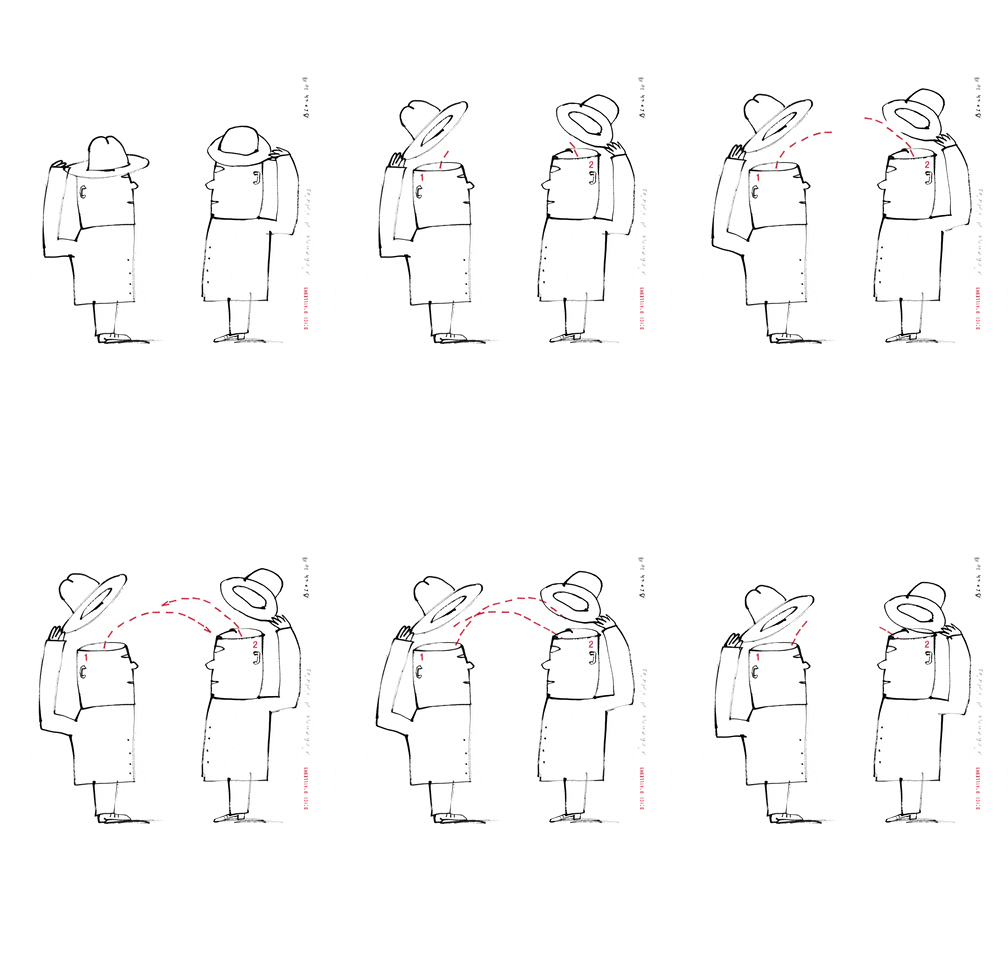
https://media.giphy.com/media/l4pSX5fLCebXGaY9O/source.gif
<iframe src="https://giphy.com/embed/l4pSX5fLCebXGaY9O" width="336" height="480" frameBorder="0" class="giphy-embed" allowFullScreen></iframe><p><a href="https://giphy.com/gifs/love-drawing-thank-you-l4pSX5fLCebXGaY9O">via GIPHY</a></p>


No comments:
Post a Comment